
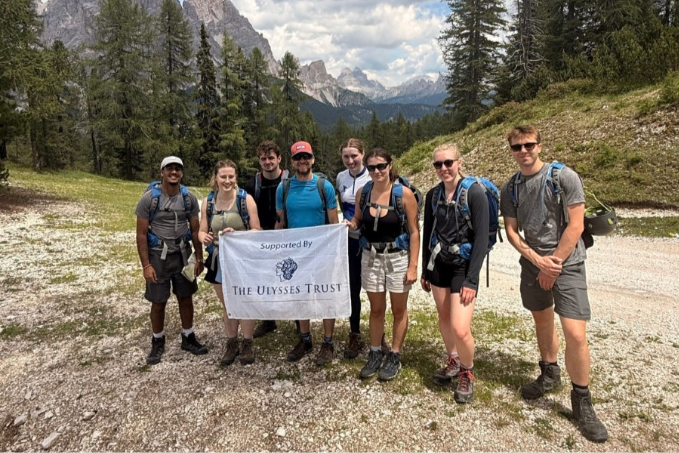
On the opening activity day of Exercise High Wire, eight students from Oxford University Air Squadron stood below the cliffs above Cortina d’Ampezzo, expecting a chairlift to carry them towards their route. The students met their first challenge – the lift was closed. Thus began an expedition of challenge, testing, and triumph. Rucksacks were tightened, and the group began the steep approach on foot. What had been planned as a neat introduction to the Italian Dolomites immediately became a test of patience, fitness and attitude.
For a week in June, the Oxford University Air Squadron swapped lecture rooms and airfields for limestone climbs, steel cables and mountain paths. Supported by two instructors, the party travelled to Cortina, in the Eastern Dolomites, where they lived self-sufficiently in two simple chalets. Their objective was to use the Dolomites’ via ferrata routes to develop confidence, leadership, resilience and teamwork in an environment that has very few equivalents in the United Kingdom.
Via ferrata means ‘iron way’. The name describes a network of protected mountain routes where steel cables, metal rungs, pins, and occasional bridges allow climbers to traverse steep ground that would otherwise require more advanced rock-climbing skills. For beginners, this system provides climbing with controlled risk while remaining technically challenging. Without a head for heights, anyone looking down between their boots at hundreds of metres of empty air can find this test of nerve one of the most significant challenges. This combination makes via ferrata in the Dolomites an ideal setting for adventurous training: safe when approached with discipline, but demanding enough to make every participant confront the limits of their comfort zone.
The students received initial climbing training at the RAF Benson high ropes course, which focused on building confidence and teamwork. Additionally, students learned via ferrata safety procedures, including clipping on, moving in a harness, and clipping safely from one protection point to the next. In the Dolomites, the practice became real. The first route, Via Ferrata Maria e Andrea Ferrari above Cortina, introduced the group to the rhythm of climbing on the rocks and clipping and unclipping again. The unexpected walk to the start, followed by a boot sole failing during the day, meant that the planned second route had to be reevaluated at the top of Ferrata Maria e Andrea Ferrari. Factors considered included the group speed, uncertainty of lifts running for the departure and a team members’ equipment failure. Taking into account the biases of the heuristics trap – the felt obligation to achieve what you has been planned, the decision was made not to complete the second climb of the day in light of the potential safety risk from the failed boot and time pressure. It was an early reminder of how adapting mountain plans is essential in the case of evolving constraints.
The second day raised both the physical and historical stakes. At Passo Falzarego, the group climbed Via Ferrata degli Alpini al Col dei Bos, a more serious route built by the Italian Alpine Troops. It was steep, sustained and very different from anything most of the students had experienced before. Nearby were the remains of First World War positions, including ruins of a field hospital and the famous Lagazuoi tunnels dug through the mountain by Italian soldiers. Moving from the exposure of mountain climbing into cold, dark tunnels gave a firm impression of the ‘White War’ – fought on the mountain front line between the Italians and the Austro-Hungarian Empire between 1915 and 1918. The students were not just climbing through dramatic scenery; they were walking through a landscape shaped by conflict, endurance and ingenuity.
By the third activity day, the group had begun to find its rhythm. The Via Ferrata Brigata Tridentina, took them into the Sella Group near Passo Gardena. It offered the classic Dolomites ingredients: steep ladders of rock, a suspension bridge and the reward of Lake Pisciadù near the top. It also delivered one of the expedition’s sharpest lessons. Progress was slower than expected as the group stopped to take in the scenery, and the descent was pushed later into the day. As the weather deteriorated and lightning began to threaten, the party had to descend quickly and with discipline. Nobody was injured, but the experience left a clear message about early starts, turn-around times and the speed with which mountain weather can change.
A lower-intensity fourth day allowed tired legs to recover while keeping the group immersed in the landscape. The students explored the Torre Latina area and the Italian side of the First World War front around Falzarego.
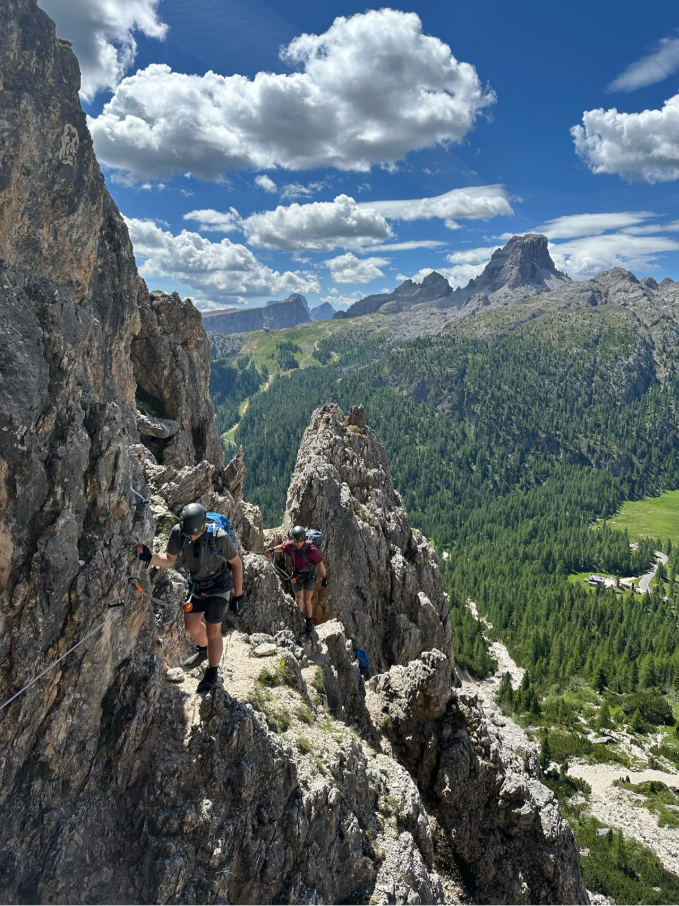
The day was valuable, but it also produced a useful lesson for future expeditions: an active recovery day in this setting might work best as a shorter and easier via ferrata rather than a walk alone.
The final day provided the expedition’s climax. The group made an early start for Via Ferrata Ski Club 18 on Monte Faloria, leaving at about 7.30 in the morning to approach in the shade and avoid both the worst of the heat and the crowds. The route was the most demanding of the week, with steep vertical sections, hundreds of metal pins and long stretches of cable. For several students who had been hesitant on exposed ground at the start of the expedition, the change was visible. Movements became calmer. Clipping became more deliberate. People who had needed reassurance earlier in the week were now managing their fear, keeping three points of contact and continuing upwards with far less prompting.
Reaching the top of Sci Club 18 produced the strongest sense of shared achievement of the week. The refuge at the top was closed, as several huts had been during the early-season period, so the group again relied on the food and water carried in their own rucksacks. By midday, they had completed the route, leaving the afternoon for a swim in the lake and the rare satisfaction of being physically tired for all the right reasons.
The expedition’s challenges were not limited to the cliffs. Living self-sufficiently required the students to take responsibility for the everyday details that make a demanding week possible: shopping, cooking, route planning, daily briefings, vehicle loading, navigation, water, nutrition and looking after shared accommodation. These tasks were not glamorous, but they built the habits that allow a team to perform under pressure. The lead student coordinated daily planning and food arrangements, others delivered briefings or managed photography and media, and the nominated drivers supported every day’s movement between accommodation and activity sites. The result was a group that became more capable as the week progressed, not only on the rock but also in how it organised itself.
That personal development was the central benefit of Exercise High Wire. Students learned how fear affects judgement, how tiredness affects morale and how small failures in preparation can have a big effect on a mountain day. They also learned that confidence is built through repeated controlled exposure, not by avoiding difficulty. The routes gave immediate feedback: a rushed clip, poor foot placement or lack of communication could be felt straight away. Equally, a calm voice from another member of the team could be enough to keep someone moving through a difficult section.
For Oxford University Air Squadron, the impact was wider than the ten people who deployed. The expedition strengthened the unit by giving junior members practical experience of planning, self-discipline and collective responsibility in an unfamiliar overseas environment. It also reinforced the squadron’s military ethos through direct engagement with the Dolomites’ wartime history. The Lagazuoi tunnels and the routes associated with the Italian Alpine Troops turned abstract ideas about endurance and service into something physical and memorable. Participants returned to the unit with stronger relationships, greater confidence in one another and a clearer understanding of how leadership is often shown in small acts: checking a teammate’s kit, carrying extra water, setting a sensible pace, or speaking up when the weather is closing in.
“Expedition High Wire was an amazing time! Going from never having done any hill walking at altitude at the start of the week to climbing a grade D via ferrata by the end of the week felt like an immense achievement. Throughout the week’s trials, the group became united by camaraderie, and we have returned home with firm friendships, being more comfortable with the unknown and renewed resilience.”
Officer Cadet Elms, Oxford University Air Squadron.
Oxford University Air Squadron
The University Air Squadron (UAS) offers a unique chance to sample RAF life. Their main role is to attract ambitious and intelligent students into a career as an RAF officer, but joining them doesn’t necessarily mean you have to join the RAF.
As well as specialist training and the chance to fly, you will learn valuable leadership and team-building skills.
You will also have the opportunity to take part in numerous sports and adventurous training such as rock climbing, skiing and sailing – both in the UK and abroad.
Follow the link below to find out more: